2025-12-06 David B. Williams – Exploring History and Nature in the City and beyond…


The Lecture – Exploring History and Nature in the City (Seattle)

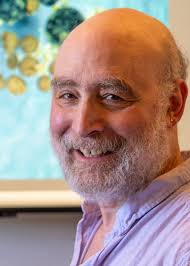
Quimper Geological Society welcomed back our friend David B. Williams, author, naturalist, and tour guide on December 6, 2025.

David B. Williams speaks about his two new books: Seattle Walks and Wild in Seattle. In his talk, David discusses how urban dwellers can get to know their city better by getting outside, walking, observing, and paying attention. He shares some of his adventures including birding at 60 mph, the pleasures and discoveries to be made by going back to the same location repeatedly, and how to date a 1100-year-old earthquake. This talk will appeal to newcomers, visitors, and longtime residents hopefully giving everyone new ways to appreciate Seattle, as well as inspire them with ways to connect with their hometown.

David will have some books available to purchase before and after the lecture.

About the speaker

David B. Williams is an author, naturalist, and tour guide whose award-winning book, Homewaters:  A Human and Natural History of Puget Sound is a deep exploration of the stories of this beautiful waterway. He is also the author of Too High and Too Steep: Reshaping Seattle’s Topography, Stories in Stone: Travels Through Urban Geology, as well as Seattle Walks: Discovering History and Nature in the City. Williams is a Curatorial Associate at the Burke Museum and writes a free weekly newsletter, the Street Smart Naturalist (https://streetsmartnaturalist.substack.com/ – by clicking the “No thanks” you may access the previous newsletters). More information about David’s books may be found at www.geologywriter.com
2025-01-11 Paul Bierman – When the Ice is Gone

THE LECTURE
Cold War Science and Engineering Today Reveals Greenland’s Fragility in an Overheating Climate


QGS hosted Paul at 4 PM on January 11, 2025

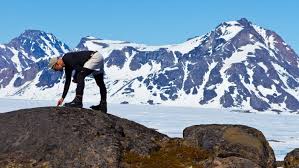
Paul’s lecture focused on how Greenland, a remote arctic island, holds in its ice enough water to raise sea level over six meters (20 feet). That is enough to flood every major coastal city and displace up to half a billion people. As he discussed, until recently we knew very little about the past comings and goings of this massive ice sheet. Through the lens of climate science, environmental history, and the stories of people who studied Greenland over the past century, Paul used the past to look into a warming future. He filled the talk with photographs, movies, and recordings from the 1930s onward, reviewed the science done by the international team that he led, and told stories from his book, When the Ice is Gone. A key finding of Paul and his fellow researchers is that the Greenland ice sheet appears to have melted away completely during a previous interglacial warm climate, which suggests it could do so again if today’s warmer climate continues. The talk was popular with those with an interest in science and history.

An additional resource to Paul’s lecture may be found on Youtube – CLICK HERE. You can find the featured book by Paul at this link: https://www.paulbierman.net/books/.

Paul’s lecture was ZOOM-only at 4 PM on January 11, 2025.

BIO

Paul Bierman, environmental science professor at the University of Vermont, develops methods to date ice and rocks. He has published in Science and Nature, with the findings covered by CNN, USA Today, and the Weather Channel. Paul is a 1993 graduate of the University of Washington (Seattle) where he earned his MS and doctorate in Geoscience after a BA at Williams College.
Paul lives in Burlington, Vermont and his passions include telling stories and solving the mysteries of our planet. He is equally at home in a dusty archive and a cleanroom without a speck of dust. A history and geoscience researcher by training and a teacher for over four decades, Paul looks at our planet with wonder and curiosity. His career has taken him to searing deserts and frigid ice sheets. Throughout, he has focused his energies on understanding the link between our Earth and human societies – what today we call sustainability. He enjoys education at all levels and is the author of three textbooks and a book for the general public, When the Ice is Gone.

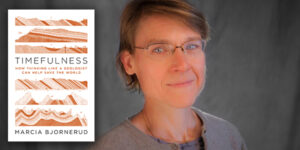
2022-12-10 Marcia Bjornerud – Timefulness

The Lecture

Developing and calibrating the geologic timescale — reconstructing Earth’s past from the raw rock record — is one of humanity’s greatest, but least appreciated, intellectual achievements.   But as a society, we are time illiterate, lacking a sense for the durations of the chapters in Earth’s history, the rates of change during previous intervals of climate instability, and the intrinsic timescales of ‘natural capital’ like groundwater systems.  This matters because environmental wrongs, social conflicts and existential malaise are all rooted in a distorted sense of humanity’s place in the history of the natural world.  Thinking like a geologist can simultaneously ground us and elevate us. Paradoxically, this Earth-bound, very physical science can yield transcendent insights.

Timefulness was longlisted for the 2019 PEN/E.O. Wilson Prize for Literary Science Writing and was a finalist for the 2018 the Phi Beta Kappa Award in Science, and the LA Times Book Prize in Science & Technology.

The Speaker
Marcia Bjornerud, Professor of Geosciences at Lawrence University in Wisconsin, is a structural geologist whose research focuses on the physics of earthquakes and mountain building. She combines field-based studies of bedrock geology with quantitative models of rock mechanics. She has done research in high arctic Norway (Svalbard) and Canada (Ellesmere Island), as well as mainland Norway, Italy, New Zealand, and the Lake Superior region.  Bjornerud is a Fellow of the Geological Society of America and has been a Fulbright Senior Scholar at the University of Oslo, Norway and University of Otago, New Zealand. A contributing writer to The New Yorker, Wired, the Wall Street Journal and the Los Angeles Times, she is also the author of several other books for popular audiences — Reading the Rocks: The Autobiography of the Earth and Geopedia: A Brief Compendium of Geologic Curiosities.