2021-10-09 George Stanley, Univ. Montana (Emeritus) — Mass Extinctions: Five and counting

Mass extinctions in geologic time: Implications for the past, present and future

During the past 400 million years of life, evidence of five mass extinction events have been detected in the fossil record. These events caused world-wide destruction and led to collapse of whole ecosystems, producing profound changes in Earth’s history and forever altered the evolution of life. Mass extinctions constitute one of the grand “unifying themes” of our planet. Study of the strata, rocks and ancient fossils related to these episodes of massive dying are revealing much insight into not only the history of our planet, but also evolution and the directionality of life. Such geologic and paleontologic studies can teach us to better understand, slow and possibly reverse the 6th mass extinction now underway. This lecture was presented via Zoom on Sat. Oct. 9th at 4 pm.

George Stanley is Professor Emeritus and former Director of the University of Montana Paleontology Center. In the Dept. of Geosciences at Montana, he taught and conducted research in paleontology and geology for 35 years.  His research has helped clarify mass extinctions, the evolution of reef structures and modern and ancient coral lineages.

He is a Fulbright Fellow and former Geologist and Research Associate at the Smithsonian Institution’s Museum of Natural History, a Fellow of the Geological Society of America, Organization for Tropical Studies, and American Association for the Advancement of Science. He has authored more than 300 professional publications and several books. His research has taken him to western Canada, northern Mexico, the Peruvian Andes, Germany, Austria, New Zealand, Japan and China. Now largely retired, he lives in Port Townsend where he enjoys hiking, nature and playing guitar.
2021-10-02 Ian Miller & Keith Denton — Field Trip: A decade of changes in the Elwha River as a result of dam removal

Quimper Geological Society Field Trip

October 2, 2021, Port Angeles Area

One-day field trip (car caravan) to see the Elwha River’s response to removal of its two dams 7 years ago (2014).  We’ll see the lower dam site, one of the dissected lake basins, sedimentation along the river’s mid-reach and the build out of the river’s delta. Ian Miller, our geologic guide, is with the SeaGrant program of the University of Washington, but resides in Port Angeles close to the action.  In addition, we recruited Keith Denton to talk about the main reason for the dams removal (fish)   Keith is a Fisheries Consultant and will discuss the recovery program that has brought salmon back to the Elwha River after a century.

Leaders:  Ian Miller, Coastal Hazards Specialist, Washington Sea Grant, Port Angeles
Keith Denton, Fisheries Specialist and Consultant, Sequim
Michael Machette, Quaternary Geologist (retired), Port Townsend

Objectives:  Visit ground zero of the largest dam-removal project in the world and one of the largest ecological restoration projects ever attempted. See the developing shore-line and take a tour of three important restoration sites along the Elwha River. Enjoy the outdoors and have enlightening discussions (socially distanced).

Click here to download the Elwha River field trip guide

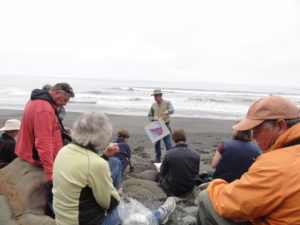
2021 Summer Geology Beach Guides–North Beach, Port Williams, & Nodule Point

2021 Summer—Three Geology Beach Walks and Detailed Guides

We led three different beach walks where you can learn more about the geology and sediments that form the bluffs and supply the beaches. Each trip ran twice.  Because of parking and logistical difficulties, attendance was limited to about 20 participants for each trip. Field trip guides are available for downloading.  This are preliminary and dynamic; we may update them as more information becomes available.

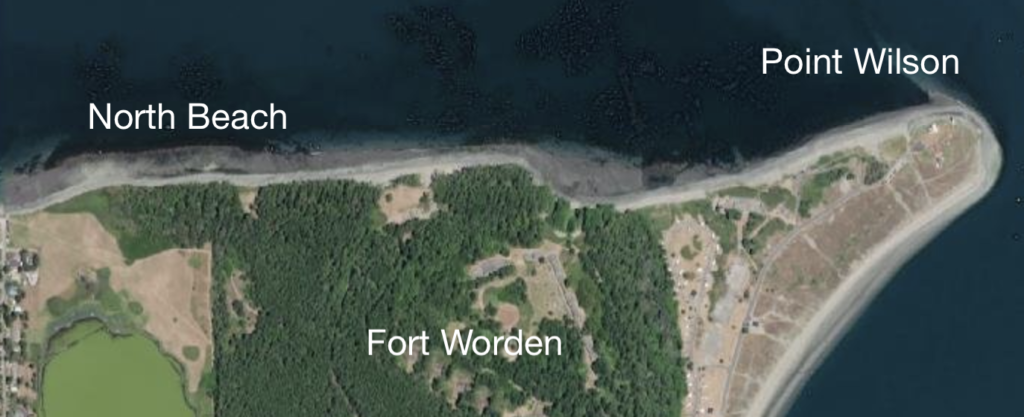
FORT WORDEN—NORTH BEACH, PORT TOWNSEND

  • Where: Meet at Fort Worden in the parking pad south of Battery Kinzie for a two-hour walk. State parks pass required to park here.
  • What: On the one-mile walk west towards North Beach county park, we’ll see a wide variety of glacial deposits including outwash and marine sediments, a peat layer, a “buried” forest, and glacial erratics on the beach. All are well exposed in a steep bluff at sea level. Generally, we walk up section (through younger deposits to the west). There are various return routes.
  • Leader: Kitty Reed, retired geologist, and several assistants.
  • For: Persons with limited geology background, easy walking across some bouldery section of beach.
  • To download the guide, 2021 NB bluff guide final.

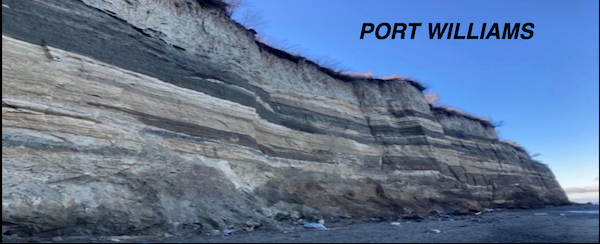
PORT WILLIAMS, SEQUIM BAY

  • Where: Meet at Port Williams, NE of Sequim for a two-hour walk. Carpooling recommended; small parking lot at this county park.
  • What: We’ll see glacial deposits, including Vashon till and Possession drift, various outwash deposits, and locally derived alluvium of the Dungeness River. All are well exposed in a steep bluff at sea level.
  • Leader: Kitty Reed, retired geologist, and several assistants.
  • For: Persons with geology background. This is the least known of the three areas we’ll visit this summer. We invite active discussion. Generally easy walking
  • To download the guide, click this link (2021 Port Williams walkers guide).

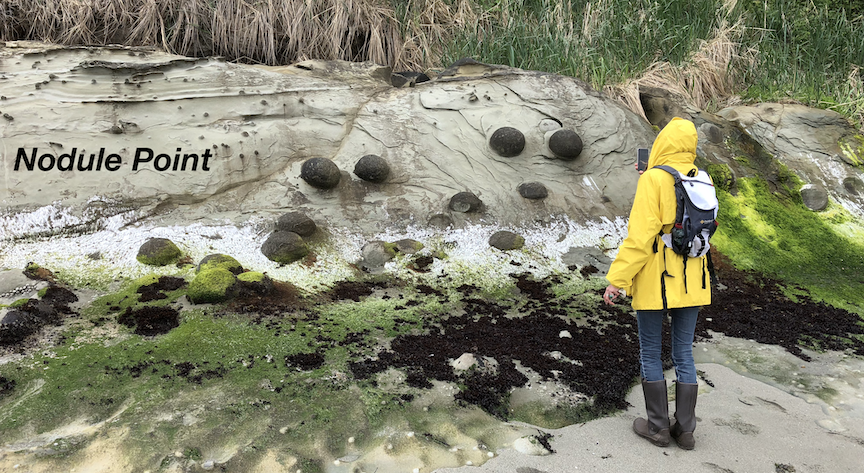
NODULE POINT, MARROWSTONE ISLAND

  • Where: Meet at the East County Beach Park,  NE of Nordland on Marrowstone Island for a four-hour walk. Carpooling strongly recommended for this small (8-10 car) parking lot.
  • What: On the four-mile walk to the Point and back, we’ll see Vashon glacial till, outwash deposits, and glacial erratics. All well exposed in a steep bluff at sea level and on the beach. At the point, well see sandstone of Scow Bay, a basalt dike that intruded the sandstone, and many cemented sandstone concretions (not nodules, despite the point’s name). They are worth the long walk.
  • Leader: Michael, retired geologist, and several geohelpers.
  • For: Persons with limited geology background. This is the only walk that encounters bedrock of the three areas we’ll visit this summer.  Moderate walking across some bouldery beach, your shows will get wet.
  • To download the guide, click this link